
Read the actual screen
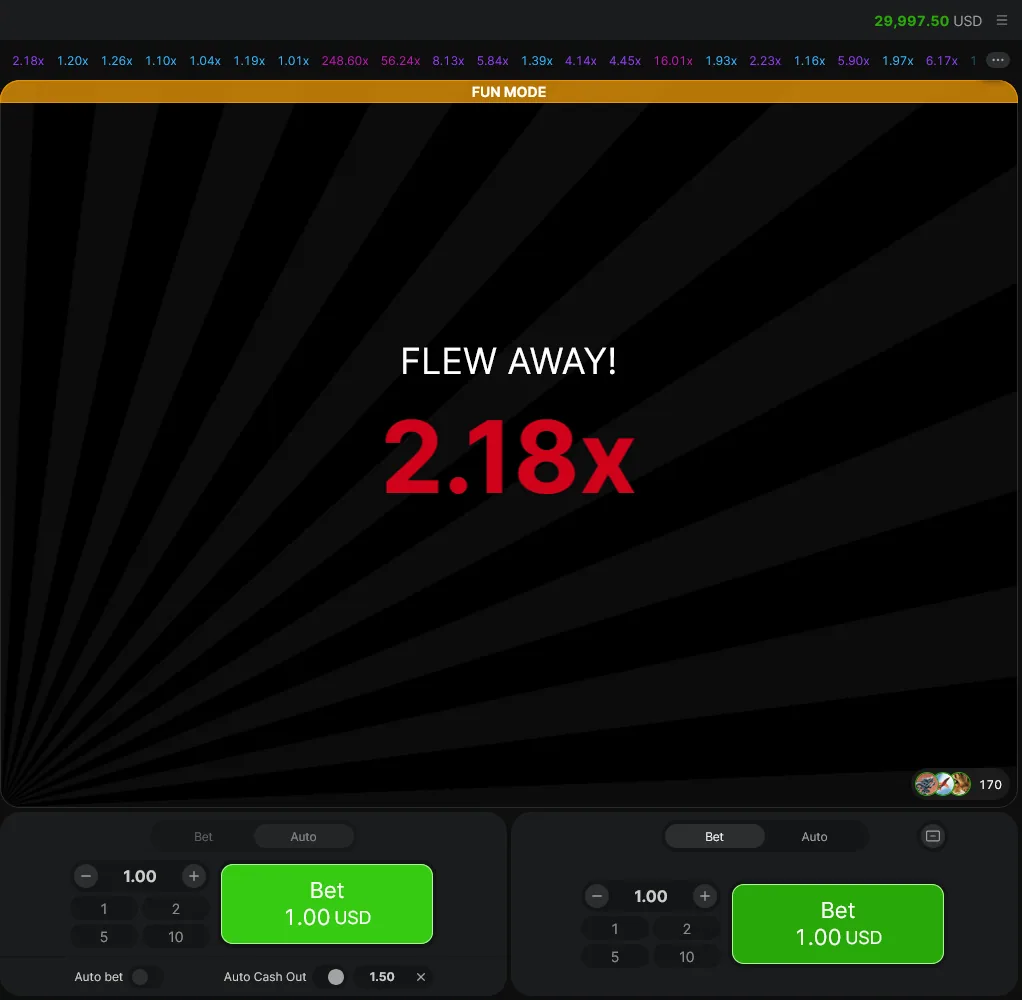
- Flight area and completed multiplier
- Left and right stake panels
- Previous completed round results
- Virtual demo balance in USD
- Game menu: rules and settings
- Auto controls on the left panel
Start with the numbers in the screenshot. The central result belongs to the flight; it is not your account balance. The history across the top contains completed results. The amount above the game is virtual USD in this capture. Do not read a displayed demo balance as money you can withdraw, and do not assume the operator you open accepts USD or the same minimum stake.
A multiplier, a balance and a returned amount are different readings
The central multiplier describes the flight, not your personal winnings. The account balance describes money or credits held in that session. A returned amount belongs to a settled bet and may include its stake. If you see a 5× flight after exiting at 1.50×, your own return remains based on the accepted 1.50× exit. Conversely, a large number on the graph does not prove that you had an accepted bet in that round. Read the three places separately before adding or subtracting money in your notes.
The previous-results strip is a list of finished flights. It helps locate a completed event and its details, but it is not a schedule for later flights. The public players list is also separate from your own bet history. Someone else’s displayed exit neither places your bet nor confirms your cashout. On a small screen, first identify your own history control and the two stake panels; otherwise it is easy to mistake a public activity notification for a change to your personal balance.
How to play Aviator, step by step
- Open the game help and identify Aviator by SPRIBE. Check the currency, minimum stake and cashout limits shown in that build.
- Choose a stake before the betting window closes. If you use two panels, set each amount separately and add both to know your total exposure.
- Confirm whether the bet is accepted for this round or queued for the next. A button press by itself is not proof of acceptance.
- While the flight is active, use Cash Out or a previously configured auto-cashout target. Check the settled record rather than relying on where the animation was when you tapped.
- Read the returned amount and subtract the accepted stake. After the flight ends, an unresolved active bet is not rescued by another tap.
- Check your balance and bet history before starting another round, particularly after a connection problem or an unexpected screen change.
Recognise the state of a bet before touching another button
An amount typed into a panel is a proposed stake. A queued instruction waits for its applicable betting window. An accepted bet belongs to a particular round and has an amount at risk. A settled cashout records a return, while a settled loss records that the active stake did not return. These stages explain why “I pressed Bet” and “I completed one round” are not interchangeable descriptions. When keeping notes, count the accepted and settled record, not the number of taps or flights you watched.
Before confirming a stake, add the amount on each active panel. Two TSh 500 panels expose TSh 1,000 to a shared flight even when the buttons are displayed separately. A preset amount left on the second panel can be overlooked after you change the first. Use a deliberate check: currency, panel A amount, panel B amount, exit targets and whether repetition is enabled. Doing this before the window opens is clearer than trying to change several controls during a rising multiplier.
If you decide not to enter a queued round, use the cancellation control provided by that build and verify the new state. Do not assume the instruction vanished because you changed tabs or closed an overlay. Once a bet is accepted, a different set of settlement rules applies; a later cancellation request is not automatically a refund. If the interface does not make the state clear, stop issuing new instructions and look at the history before deciding what needs to be reported.
Walk through the decision
Betting window: the example stake has not been accepted yet.
The illustrative flight always ends at 2.40×. Steps 1–3 show acceptance, flight and what waiting until the end changes. No money, random outcomes or actual bets.
Our illustrated flight ends at 2.40×. It is deliberately fixed so you can compare the same case twice. Cashing the TSh 1,000 example at 1.50× returns TSh 1,500. Waiting until the illustrated end returns nothing. A real next round need not resemble this one, and the amount already shown on a rising curve is not reserved for you until a cashout settles.
A full example includes the opening balance, accepted stake, return and ending balance. Start with TSh 10,000 and accept a TSh 1,000 stake. A settled 1.80× exit returns TSh 1,800, giving an ending balance of TSh 10,800 before any account-level charges. That is TSh 800 net profit. If the next equal stake loses, the balance becomes TSh 9,800. Reporting only the first TSh 1,800 notification would hide both the original stake and the second-round loss.
The example’s fixed crash exists to explain timing. You can repeat it because this illustration is deterministic, whereas the next real flight is not provided to you in advance. A learned sequence of button presses is therefore not a learned winning sequence. Use the walkthrough to answer “which instruction was accepted and what settled?” rather than to learn how long to wait after take-off. There is no seconds-to-multiplier conversion in this guide that can forecast the next live round.
Two panels: one flight, two separate stakes
Suppose panel A stakes TSh 1,000 with a 1.50× target and panel B stakes TSh 1,000 with a 3× target. If the flight ends at 2.40× and A’s cashout settled, A returns TSh 1,500 and B returns zero. You staked TSh 2,000 altogether, so the net result is −TSh 500. Counting the TSh 1,500 notification as profit would reverse the meaning of the round.
Enter stake A, its target, stake B, its target and an illustrative final multiplier. Set B to zero to use one panel. Green and red apply to net profit or loss, not to stakes or gross returns. The worksheet assumes targets below the crash settle successfully; at an exact tie it marks the example unresolved rather than guessing server ordering. It does not model network delay, operator limits, fees or taxes.
Compare three endings using the same two stakes
The same flight can produce two different receipts
Hold the illustration at a 2.40× crash and assume A has an accepted TSh 1,000 bet with a settled 1.50× exit. A returns TSh 1,500. The decisive extra question is whether B’s TSh 1,000 was accepted for that same flight or only queued for a later one.
| B’s actual state | Accepted stake on this flight | Returned | Net for this flight |
|---|---|---|---|
| Accepted at TSh 1,000; 3× target not reached | TSh 2,000 | TSh 1,500 | −TSh 500 |
| Only queued for a later flight | TSh 1,000 | TSh 1,500 | +TSh 500 |
This is hypothetical accounting, not two recorded study rounds. Read the first column as the confirmed status of B, not the amount typed into its input. The queued instruction can still affect a later flight; it is not cancelled or made risk-free by this table. Both accepted panels share one flight, so separate buttons do not make their crash risks independent.
For a two-panel result, subtract both accepted stakes even when only one return appears. If panel B was never accepted, however, do not invent its loss simply because an amount was visible in the input. Match the panels to their settled records for the same flight. This also matters when comparing screenshots: one person’s one-panel profit cannot be compared with another person’s combined balance movement unless the accepted stakes and any second panel are known.
Auto Cash Out and Auto Bet solve different tasks
Auto Cash Out is a preselected exit target. Auto Bet repeats a betting instruction under the controls available in that build. Turning on one does not mean you enabled the other. Check the amount and target on each panel before enabling repetition. If you only want to learn the interface, use virtual credits and leave repeated betting off. An automatic control is not an instruction to keep adding funds.
A cancelled queued bet and a lost accepted bet are different events. After any interruption, first look for the round ID and status in your own history. Do not open duplicate tabs and submit the same instruction repeatedly while trying to work out what happened. Save a screenshot with private account details hidden if you need support.
Treat automatic settings as instructions to inspect, not as a package called a strategy. You might use a fixed exit with manually placed stakes, or repeated stakes without that exit. The particular build decides which controls can be combined. After changing a target, read the value back on each panel. If a control is unavailable or disabled, do not assume the target is active because you typed it elsewhere. A fresh session or a different operator build may show different defaults from the archived image.
Decide how a session ends before enabling repetition. A limit should be an amount you can afford to lose, not an amount you intend to recover by a larger next stake. If a displayed profit or loss threshold is available, check whether it stops a future instruction or affects an already accepted round; these are not the same action. After stopping, look at the settled history and the repetition state. Restarting immediately with a higher stake changes the exposure that the original limit was meant to contain.
Popular strategies: what changes and what does not
| Rule | What you change | Main limitation |
|---|---|---|
| Fixed stake | Same amount each accepted bet. | Losses accumulate without stake escalation. |
| Martingale | Double after a loss, reset after a win. | A short losing sequence can exceed the bank or stake cap. |
| Paroli | Increase after wins, reset after a defined sequence or loss. | An increased stake can lose the earlier gains. |
| Wait for low rounds | Skip rounds until a chosen past-results pattern occurs. | A pattern is not evidence about the next undisclosed crash. |
| Two panels | Split stakes across two exit targets in the same flight. | The second loss can outweigh profit on the first panel. |
| Stop limits | End a session at a chosen loss or profit limit. | A limit changes exposure, not the game result. |
Consider a doubled stake sequence of TSh 500, 1,000, 2,000, 4,000 and 8,000. Five losses cost TSh 15,500, and the next requested stake would be TSh 16,000. A small planned profit can therefore require much more money than the first bet suggests. A stake cap or limited balance can end the sequence before a recovery attempt. This arithmetic is not a recorded Aviator session.
At a fixed 2× cashout, ten equal stakes need more than five wins for a positive net result before fees: five wins merely break even. At 1.50×, two wins and one loss break even with equal stakes. A lower target returns money more often only when it is reached; it does not remove early crashes. These break-even examples do not supply the missing win probability.
Read the signal and predictor checks →Ten familiar rules, explained with their actual stake decisions
1. Fixed stake: choose a unit such as TSh 500 and keep it unchanged across accepted bets. At a 2× exit, a win adds one unit and a loss removes one. Three wins and two losses across five equal bets therefore net one unit, TSh 500, before fees. The advantage of this rule is that the exposure is easy to audit; it has not established that wins will outnumber losses. Decide the total affordable exposure separately from the size of one unit.
2. Percentage of balance: recalculate the stake as a fraction of the current bank. One percent of TSh 20,000 is TSh 200; after the bank falls to TSh 15,000 it is TSh 150. This changes stake size as the bank changes. Minimum stakes, rounding and a maximum-stake limit can prevent the literal fraction from being used. A percentage rule can slow the size of later losses, but a smaller balance still represents lost money rather than proof that the system is recovering.
3. Martingale: increase after a loss, commonly by doubling, and reset after a win. At 2×, a sufficiently large successful recovery stake can cover earlier losses and one base unit in the simplified sequence. The problem is financing the unsuccessful sequence before that hypothetical win. Four losses of TSh 500, 1,000, 2,000 and 4,000 already cost TSh 7,500. The next TSh 8,000 stake is larger than all four earlier stakes combined. A cap changes the sequence rather than making the next result favourable.
4. D’Alembert: add one base unit after a loss and subtract one after a win, usually without going below the starting unit. A TSh 500 base might produce TSh 500, 1,000 and 1,500 after successive losses. Growth is slower than doubling, but a long losing period still builds a larger stake and accumulated losses. Write the exact minimum, maximum and reset rule down. Without those details, two people saying they use D’Alembert may actually be following different money sequences.
5. Fibonacci: move through units such as 1, 1, 2, 3, 5 and 8 after losses, then move back by a stated rule after a win. With a TSh 500 base, the eight-unit step (the sixth position listed) is TSh 4,000. Choosing how many positions to move back, which exit target to use and what happens at the stake cap is part of the rule. The familiar number sequence supplies a stake progression; it supplies no information about the flight that will decide whether that stake returns.
6. Paroli: increase after wins and reset after a loss or a chosen winning sequence. At a 2× target, a 1–2–4-unit sequence can build an attractive return when all three bets win. If the final four-unit bet loses, much of the earlier gain disappears. Specify whether the increase uses the previous gross return or a separate fixed amount; those produce different exposure. A winning sequence shown without the resets and failed sequences is not a complete account of this rule.
7. The 1–3–2–6 sequence: use those unit amounts after successive wins, resetting at a loss or after the fourth win. A TSh 500 unit makes the steps TSh 500, 1,500, 1,000 and 3,000. It deliberately changes how much of earlier gains is exposed at each step. Compare a completed four-win sequence with a loss on each possible step rather than judging only the best ending. The name describes stake order, not a special cashout setting built into Aviator.
8. Waiting for low results: define a threshold, count consecutive completed results at or below it and bet only after the condition occurs. For example, a rule may wait for four results at or below 2×. That creates skipped rounds and a smaller number of accepted bets. Keep the skipped rows in any evaluation so the trigger can be reproduced. A low-results pattern does not establish that a higher flight is due, and choosing its best threshold after viewing the history can exaggerate apparent success.
9. Split targets on two panels: choose the total stake first, then divide it, rather than quietly doubling exposure. A TSh 1,000 budget split into two TSh 500 stakes differs from placing TSh 1,000 on each panel. The early target can return one part while the later target loses. Calculate the combined net before calling the early exit insurance. Both stakes depend on the same flight, so treating them as two independent chances misdescribes the arrangement.
10. Stop-loss and take-profit limits: end the planned session when a stated net result is reached. A TSh 2,000 loss limit with TSh 500 stakes defines four full-stake losses from the starting balance in a simple all-loss example. If bets vary or two panels are active, the next settled result can cross the limit by more than one unit. Specify whether a later session starts with the same bank and rule. Repeatedly restarting after a stop removes the meaning of a session-level limit.
Is there a secret to winning Kindege?
Past results can describe what happened; they do not tell you the undisclosed next result. “Wait for four low rounds” defines when to bet, but does not prove the next flight must be high. To evaluate such a rule you would need a complete ordered history, a rule fixed before seeing new results, stakes, fees and every skipped round. Choosing the most profitable settings after looking at the same history is fitting to that history.
The provider publishes theoretical RTP of 97%. That is a long-run game characteristic, not a promise that your deposit will return 97%, and not a measurement made by this site. A short session can finish above or below that figure. Stop limits can limit planned exposure if respected; they cannot force a profitable session.
For a meaningful comparison, keep the same starting bank, stake unit, available rounds and completion rule. A strategy that stopped after a quick gain should not be presented as if it survived a longer losing stretch it never entered. Equally, a rule that reached a stake cap has a different result from one that completed every planned bet. These are evaluation details, not hidden winning codes. These explanations use illustrative arithmetic. Our separate 333-bet study now compares recorded demo outcomes and clearly labelled historical replays.
If the phone freezes or cashout looks late
Separate the display from the settled record. Record the local time with EAT (UTC+3), round ID, stake and the result in My Bets. After reconnecting, check whether the bet was accepted and whether a cashout settled. The animation alone cannot decide a dispute. An SMS about an M-Pesa payment also cannot prove that a game cashout was accepted.
Use the payment and settlement checklist →Make a short round record that another person can understand
Write the round ID, EAT time, currency, panel A and B stakes, the exit instruction you intended and the settled status you can actually see. For example: “20 October, 14:05 EAT; A TSh 500 accepted; B off; I tapped Cash Out; history shows a loss; please explain the settlement for round …”. State uncertainty honestly rather than replacing a missing record with the multiplier you remember. Support can investigate an identified event more easily than an account of many repeated taps without a matching round.